

Tubal Ligation & Reversal
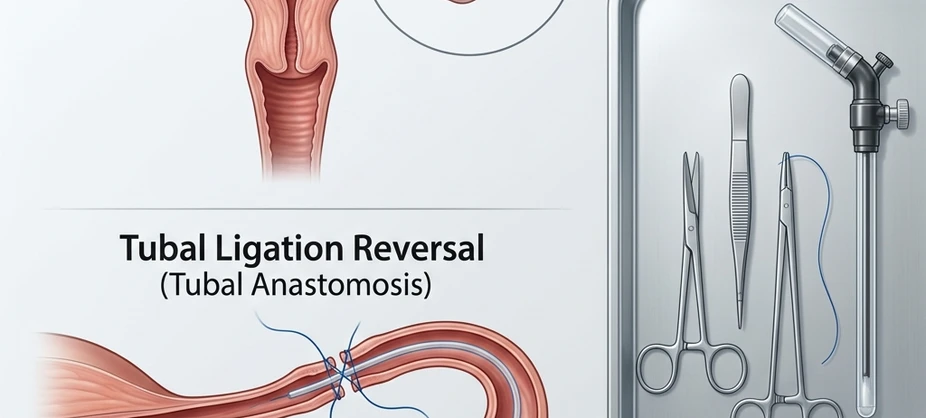
What is Tubal Ligation & Reversal?
Tubal Ligation (Tubectomy) is a highly reliable, permanent surgical birth control method for women who decide their families are complete. Conversely, Tubal Reversal (microsurgical tubal re-anastomosis) is a delicate reconstructive surgery performed to reconnect blocked fallopian tube segments, helping women restore their natural fertility pathway if they decide they want more children.
At Dr. Poonam's Women's Clinic, recognized as a leading center for gynecological surgery and family planning in Keshav Nagar and Mundhwa, Pune, we support women through every reproductive phase. Dr. Poonam offers laparoscopic tubal ligation as a quick daycare procedure and performs highly advanced microsurgical tubal reversals to reconstruct fallopian pathways for couples planning a new pregnancy.
Because we run a focused, single-doctor private clinic rather than a busy corporate hospital, your surgical planning and counseling are conducted personally by Dr. Poonam. We operate by prior appointments to ensure that every patient receives absolute privacy, meticulous attention, and clinical accuracy in a highly sterilized clinical environment.
Tubal Ligation vs. Tubal Reversal Comparison
While ligation is a quick, straightforward procedure to permanently block the tubes, reversal is a highly complex microsurgery designed to meticulously put them back together.
Tubal Ligation (Tubectomy)
Permanent Sterilization. Contraception.
Provide highly reliable, permanent sterilization to prevent future pregnancy.
Quick surgical execution, typically taking 20 to 30 minutes to complete.
Fallopian tubes are cut, tied, sealed using heat (electrocautery), or clipped.
Offered as a daycare procedure; patients return home the same day.
Boasts over 99% efficacy in preventing pregnancy; highly secure contraception.
Tubal Ligation Reversal
Fertility Reconstruction. Re-anastomosis.
Reconstruct the fallopian tubes to restore natural fertility pathways.
Delicate microsurgery requiring 2 to 3 hours of precise micro-suturing.
Removing blocked scar segments and joining healthy ends using microscopic sutures.
Typically requires a 1 to 2 night inpatient admission for observation.
Success averages 40% to 80% depending on age, tube length, and sterilization type.
Key Factors Influencing Reversal Success
Not everyone is a candidate for tubal reversal. Dr. Poonam conducts a rigorous clinical evaluation of these primary success indicators to give you a realistic success probability.
Original Sterilization Method
Tubes blocked with medical clips or rings suffer the least damage and are easiest to reverse. Tubes closed using electrocautery (burning) have lower success rates.
Remaining Tube Length
For a successful microsurgical re-anastomosis, at least 4 cm of healthy, vascularized fallopian tube must remain on both sides to facilitate egg transport.
Maternal Age & Ovarian Reserve
Maternal age directly dictates egg quality. Reversal outcomes are highest in women under 35 with confirmed normal reserves (AMH) and ovulation.
Partner's Semen Parameters
Prior to undertaking a reversal, a complete semen analysis for the partner is mandatory to ensure natural conception is biologically feasible.
Our Pre-Surgery Preparation & Safe Guidelines
Reconstructing fallopian pathways requires surgical precision and pre-operative preparation. Let us review the primary guidelines.

Microsurgical Diagnostic Audit
Retrieving previous surgery records and conducting a hysterosalpingogram (HSG dye test) to measure remaining tube segments and verify uterine health.
Sterilized Anesthesia Mapping
Reversals require microsurgery under general anesthesia. Pre-anesthetic checkups (blood profiles, ECG, chest X-rays) are completed for physical fitness.
Uterine Healing & Recovery Plan
Following post-operative instructions: resting for 7-14 days at home, avoiding lifting objects, and maintaining clean, dry dressings over the mini-laparotomy cut.
The Reversal Microsurgery Journey
Microsurgical tubal re-anastomosis is an incredibly delicate reconstructive surgery. Let us walk through our precise clinical journey map.
Every treatment and procedure at our clinic is performed with the highest standards of safety, compassion, and expertise. Dr. Poonam ensures each step of your journey is carefully monitored and optimized for the best possible outcomes.
Expert Guidance
From your initial consultation through recovery, our dedicated team is here to support you with personalized care, ensuring your comfort and peace of mind at every stage.
Step 1: Diagnostic Workup & Reversal Candidate Check
Reviewing past surgical notes, performing transvaginal ultrasounds, testing ovulation AMH levels, and conducting semen assays for the partner.
Step 2: Anesthesia & Mini-Laparotomy Access
Under general anesthesia in a highly sterilized hospital environment, a small horizontal mini-laparotomy incision is made just above the pubic hairline.
Step 3: Microsurgical Re-anastomosis
Using high-magnification surgical scopes and ultra-fine sutures, Dr. Poonam carefully dissects scar tissue and re-aligns the inner layers of the fallopian tubes.
Step 4: Dye Patency Verification & Closure
A blue dye is flushed through the fallopian tubes (chromotubation) to confirm they are open and leak-free, followed by precise layer-by-layer closure.
Why Choose Dr. Poonam's Women's Clinic for Tubal Ligation & Reversal?
Google Rating
Based on 42 Reviews
- Specialized Microsurgical Reconstructive SkillsAdvanced surgical expertise in high-magnification fallopian reconstruction. Dr. Poonam conducts micro-suturing layer alignment with extreme clinical accuracy.
- Daycare & Advanced Hospital OptionsLaparoscopic permanent sterilizations are managed as quick daycare operations. Microsurgical reversals are conducted under strict sterile setups in leading tertiary centers.
- Dedicated Prior-Appointment BookingWe maintain a single-doctor clinical setup. We operate strictly by prior appointment during dedicated morning and evening timings, preventing waiting room crowds and securing patient privacy.
Google Rating
Based on 42 Reviews
Frequently Asked Questions
Tubal ligation (female sterilization or tubectomy) is a permanent contraception method where the fallopian tubes are clipped, tied, cut, or sealed. This blocks the egg's pathway, boasting an effectiveness rating exceeding 99% against future pregnancies.
Laparoscopic tubal ligation is a quick day-care procedure. Under general anesthesia, a small incision is made near the navel. A laparoscope is inserted, and the fallopian tubes are closed using medical clips, bands, or by cutting and tying them.
Pregnancy success rates after tubal reversal (tubal re-anastomosis) range from 40% to 80%. Success depends heavily on the mother's age, the remaining length of healthy fallopian tubes, and the sterilization method originally used.
We maintain clear pricing transparency. A laparoscopic daycare tubal ligation (tubectomy) typically ranges from ₹25,000 to ₹40,000. An advanced microsurgical tubal ligation reversal (requiring hospital stay, microsurgical equipment, and general anesthesia) ranges from ₹70,000 to ₹1,20,000 depending on complexity.
For laparoscopic ligation, recovery takes 3 to 5 days, and most women return to light work within a week. Reversal surgery is more complex and may require 1 to 2 weeks of recovery time before returning to normal activities.
Dr. Poonam's Women's Clinic operates strictly by prior appointment during dedicated morning and evening hours. This is a private, single-doctor clinical setup designed to provide unhurried consultations and maintain a highly sterilized clinical environment, rather than a 24/7 walk-in model. Contact us directly to book a consult.